
WHAT ARE NEMATODES?
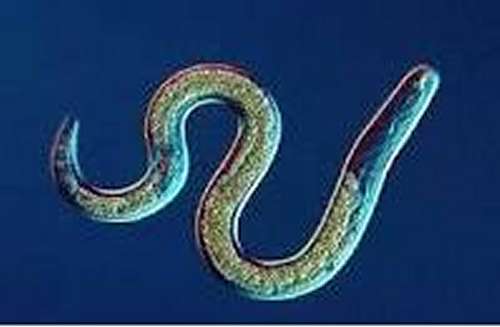
Nematodes are small worms that burrow into plant roots, preventing them from developing and growing properly. The plants most commonly affected by these pests are potatoes, tomatoes, aubergines and tobacco.
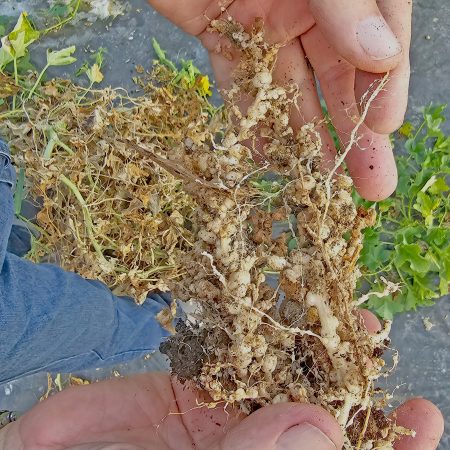
Nematodes pierce and suck on the plant’s tissues, causing them to change and leading to the formation of galls, the characteristic symptom of an infestation. As they pierce the plant, they can inject dangerous viruses into it.
WHAT ARE THE SYMPTOMS OF NEMATODES?
ABOUT PLANTS
Plants infested with nematodes show the following symptoms:
- a delay in vegetative growth because nutrient uptake by the roots is reduced,
- low output, both in terms of quality and quantity,
- greater susceptibility to the effects of other pathogens,
- a poorly developed root system,
- yellowing and wilting of the leaves, leading to premature death.
Fungi and bacteria that cause root rot may be more likely to establish themselves on affected roots. Furthermore, nematodes cause indirect damage as they can act as vectors for viruses.
ON THE GROUND
In the soil, the symptoms of a nematode infestation manifest as what is commonly referred to as ‘soil fatigue’: it is therefore highly likely that, by the time the presence of nematodes is detected, they will have already completely colonised and infested the soil. Nematodes do not move particularly quickly, but they reproduce at a very high rate.
Request a consultation now!
HOW TO GET RID OF NEMATODES FROM THE SOIL.
As they live in the soil, they easily evade direct control measures carried out by humans; furthermore, they are highly resistant to adverse environmental conditions, withstanding both periods of intense cold and periods of severe drought with ease.
Nematodes also have a cuticle consisting of seven layers, which provides them with effective protection even against toxic substances.
A GOOD ROTATION PLAN
Here are some useful tips on what to do to get rid of these pesky pests and on the preventative measures you should carry out on a regular basis to stop the problem from recurring.
When choosing treatments for nematodes, the first useful piece of advice is to have a good crop rotation plan.
Very often, nematode infestations are caused by the use of already infected planting material, such as tubers, bulbs or seeds, and, to a greater extent, by soil depletion resulting from the abandonment of crop rotation.
Among natural nematicides, there are many wild plants that produce root exudates which are toxic to numerous species of nematodes found in agricultural crops: these act as a barrier, using their own exudates to prevent the nematodes from detecting those of their host plants
The presence of many different root systems belonging to various species and families is therefore generally a disadvantage for nematodes: consequently, practices such as grass cover, green manure, intercropping with grasses and companion planting are excellent ways of preventing the emergence and spread of these pests.
Eradicating these pests from the soil is very difficult, as it would require the use of methods and techniques designed to create what is known as a ‘biological vacuum’, not least because of the nematodes’ resistance to various treatments.
As we mentioned at the start, infestations by these pests are encouraged by conditions of ‘soil exhaustion’; therefore, many of the practices implemented to address this situation are in fact the same ones that would help to control nematodes over time (extending crop rotations, introducing soil-improving crops and green manure, applying farmyard manure, etc.).
Request a consultation now!
METHODS FOR CONTROLING NEMATODES:
1. TRAP PLANTS
There are numerous techniques that can be used to eliminate nematodes.
Green manuring, intercropping or temporary grass cover are effective in controlling nematodes, provided that the introduced plants remain in place for at least two to four months.
Less commonly used, however, is the technique involving the use of trap plants. Some plants are particularly ‘appealing’ to nematodes, so the technique involves sowing these plants and then uprooting them once the nematodes have penetrated their roots, before destroying them. However, due to the difficulty involved in controlling nematodes, this technique often fails to deliver the desired results and merely increases the risks.
2. FUNGI, BACTERIA AND INSECTS
Nematodes have many natural enemies: fungi, bacteria, insects, other nematodes and viruses. The more fertile the soil is and the richer it is in organic matter, the greater the populations of these beneficial organisms will be.
These fungi are able to build actual traps using their hyphae, trapping nematodes.
Recently, many bio-factories have developed preparations containing this type of fungus, known as nematode parasites: for this method to be effective, the use of these substances must form part of a broader, long-term strategy.
3. SOIL STERILISATION
All those techniques that involve soil sterilisation, whether by chemical or physical means (dry or moist heat), are not entirely effective, as they create a biological vacuum. Under such conditions, life is very easy for nematodes, and they would therefore reproduce undisturbed.
4. OTHER TECHNIQUES
Macerates, infusions, decoctions or other spray treatments can protect the host crop, but they are difficult to apply as they require large volumes of water and frequent applications, and their beneficial effect is short-lived.
THE REAL SOLUTION? PREVENTION.
The real fight against nematodes is a preventative one and involves, first and foremost, restoring good organic fertility and soil vitality. Only in this way can the micro-organisms present in the soil act to control and suppress nematodes.
Particular attention must be paid to the quality of the propagation material used: whilst the active forms of nematodes are destroyed by moderate heat, the cysts survive even at temperatures above 70 degrees.
If there is a real possibility that the plant material is infested with nematodes, it is always best to dispose of it separately. The temperatures generated by a compost heap during the composting process are not high enough to guarantee the destruction of the cysts. The intense microbial and enzymatic activity taking place in the heap severely affects the nematodes, both chemically and parasitically.
Whilst it is true that composting has the potential to destroy plant-parasitic nematodes, it is not an exact science; enzymatic processes do not always proceed optimally, and not all parts of the compost heap heat up in the same way.
Composting is not only a way of treating waste that we consider hazardous because it is infested with nematodes, but it is also a vital means of maintaining and enhancing soil fertility.
TOMATO NEMATODES.
As mentioned in the introduction, one of the plants most commonly affected by nematodes is the tomato, particularly when it is grown intensively or as a monoculture.
How can you control tomato nematodes?
The first step is to use agrochemicals with nematicidal properties, in order to safeguard the quality of the produce. However, whilst this initial measure is important, it can in many cases prove counterproductive if not used appropriately.
It is possible to keep nematode damage within an economically acceptable threshold not only by using these substances, but also by employing alternative methods. This involves clearing the soil of infested plants and using soil, tools, water and other seedlings that are free from nematodes. As already mentioned, drainage and crop rotation are very important.
The technique of herbaceous grafting is widely used in tomato cultivation; other alternative methods include: solarisation, which involves covering the soil with a transparent plastic sheet for around two months during the summer; and steam sterilisation. Finally, there is biological control using numerous naturally occurring microorganisms, which kill nematodes through various mechanisms.
Combining or even alternating these different methods certainly allows for greater control over nematode activity and the presence of toxic residues.
PRODUCTS FOR CONTROLLING NEMATODES.
Un valido prodotto per combattere nematodi è ERGOFERT NEMACONTROL , un concime organico a base di azoto adatto per la fertirrigazione e la concimazione fogliare di tutte le colture.
This product acts very quickly, achieving several objectives: it reduces the proliferation of nematodes and, like all fertilisers, nourishes the plants. The presence of endogenous and exogenous enzymes in this product detoxifies the rhizosphere environment. This is a very important environment because it is where the plant’s roots are located.
ERGOFERT NEMACONTROL’s action boosts microbial activity, which revitalises the soil.